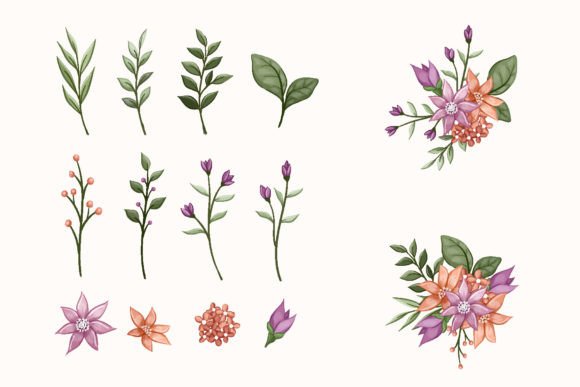
Botanic Blossom Floral Foliage Elements: A Practical Resource Analysis
For professionals and creators working in digital design, the search for high-quality, versatile graphical assets is a constant task. The Botanic Blossom Floral Foliage Element and Set represents a specific type of resource aimed at fulfilling needs in this area. It is a collection of vector illustrations centered on botanical themes, including branches, leaves, herbs, wild plants, and flowers, often presented isolated on a white background. This analysis examines its characteristics, practical value, and suitability for various projects, avoiding promotional language to focus on its objective utility.
Core Characteristics and Purpose
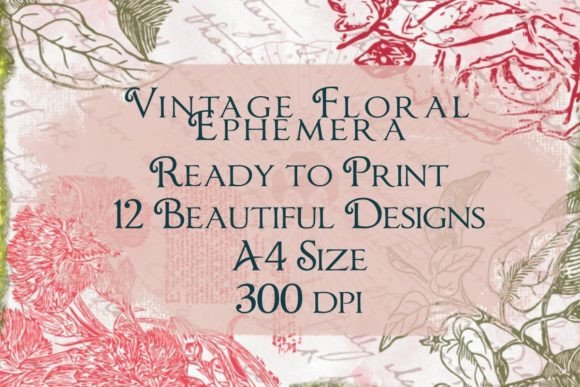
At its essence, this resource is a curated set of floral and foliage graphics. The key terms used to describe it—garden, meadow, field collection, foliage, branches—point to its scope. The illustrations typically emphasize a natural, often beautiful or vintage aesthetic, suitable for themes like summer, spring, botanical gardens, weddings, and general decoration. The primary purpose is to provide designers with ready-made, scalable elements that can be integrated into larger compositions without the need to illustrate each botanical component from scratch.
The set’s strength lies in its foundational concept: isolation on a white background. This is a critical feature for vector assets, as it allows for clean extraction, easy layer manipulation, and seamless placement onto other backgrounds or within existing layouts. The “vector” designation ensures that the graphics are resolution-independent, scalable to any size without loss of quality, which is a non-negotiable requirement for professional print and digital output.
Practical Value in Design Workflows
Integrating such a set into a real-world workflow can significantly expedite the initial design phase. For instance, a marketing professional creating a campaign for a gardening brand, a freelancer designing wedding invitations, or a blogger producing seasonal website graphics might use these elements as foundational blocks. They can be combined, colored, layered, and modified to fit the specific tonal and visual needs of the project.
The practical value is measured in time saved and consistency achieved. Instead of sourcing or creating disparate leaf and flower illustrations that may have inconsistent line weights or artistic styles, using a cohesive set like the Botanic Blossom Floral Foliage Element guarantees visual harmony. All elements share a common artistic hand, which results in a more polished final composition. This reliability is particularly important for projects requiring multiple related graphics, such as a series of social media posts, a website’s thematic icons, or printed materials for an event.
Assessment of Quality and Usability
Quality in such a resource is judged by several technical and artistic factors. First, the cleanliness of the vector paths is paramount. Well-constructed vectors should have minimal unnecessary nodes, allowing for smooth editing and transformation. The artistic quality—the realism, stylization, or vintage appeal—must match the descriptions. A set advertised as “beautiful botanical” should exhibit careful attention to natural details or an appealing illustrative style.
Usability extends beyond just opening the file. The organization within the set greatly affects its effectiveness. Are elements logically grouped or named? Can individual leaves or flowers be easily separated from larger branch assemblies? A well-organized set allows a designer to find and use specific components quickly, enhancing long-term value as the resource can be revisited for different projects over time. Flexibility is another key metric. Can these predominantly green, natural-colored elements be easily recolored to match a brand’s palette, perhaps for a non-traditional wedding or a corporate sustainability report? The ability to manipulate vectors without degradation is where their true power lies.
Potential Limitations and Considerations
While the benefits are clear, there are realistic limitations to consider. The aesthetic is fixed. If the set employs a specific vintage line-art style, it may not suit a project demanding ultra-modern, minimalist, or hyper-realistic 3D visuals. The included flora are also predefined; you cannot find a rare, specific orchid if it was not included in the original collection. Therefore, its utility is bound by its initial artistic direction and scope.
Another consideration is file format and software compatibility. While vectors are often supplied in EPS or AI formats, universal accessibility via SVG or editable PDF can be important for users across different software platforms. It is a practical detail a professional must verify before acquisition. Furthermore, over-reliance on pre-made elements can sometimes lead to a homogenized look if used without creative adaptation. The most effective use involves treating these elements as a sophisticated starting point—customizing, combining, and integrating them with original work to produce a unique final result.
Who Benefits Most from This Resource?
The audience for such a set is broad, aligning with the described group of professionals, entrepreneurs, and serious hobbyists. Graphic designers and freelancers across many fields benefit directly, using these assets to speed up client work on nature-themed projects. Marketers and small business owners, especially in niches like eco-products, wellness, floristry, outdoor events, or organic brands, can use these graphics in their promotional materials to quickly establish an appropriate visual tone.
Bloggers and publishers focusing on gardening, travel, wedding content, or seasonal lifestyle topics can integrate these elements into featured images, infographics, or website design to enhance visual appeal. Educators creating materials for biology, environmental studies, or art projects might find them useful for creating clear, attractive diagrams and handouts. Finally, crafters and hobbyists engaged in digital crafting for printables, wedding DIY, or sublimation design can utilize these vectors within their specialized software.
The situations where this resource fits best are projects with a clear thematic link to nature, beauty, gardens, seasons, or celebration. It is less suited for abstract, technical, or unrelated commercial themes. Its value is highest when the project’s timeline is tight, the budget for custom illustration is limited, or when a consistent botanical visual language needs to be applied across multiple deliverables.
Final Observations on Long-Term Value
A quality vector set is not a one-time purchase for a single project. Its long-term value is anchored in its reusability and adaptability. A comprehensive Botanic Blossom Floral Foliage Element set, with a wide variety of leaves, flowers, and branches, can become a permanent part of a designer’s asset library. As new projects arise with tangential needs—a spring sale graphic, a herbal product label, a garden center brochure—the same set can be mined again, with different elements selected and modified.
To determine if this resource fits your needs, evaluate your common project types, your software’s compatibility with the provided file formats, and your willingness to customize pre-made assets. If your work frequently intersects with the themes of nature, flora, and organic beauty, and you require a reliable, scalable, and aesthetically cohesive set of starting components, then such a collection offers measurable practical utility. However, if your needs are highly specific or demand a radically different artistic style, its usefulness may be limited. The key is to match the resource’s inherent strengths—its botanical focus, vector flexibility, and stylistic direction—with the genuine requirements of your professional or creative output.